 В Атырау +16.8
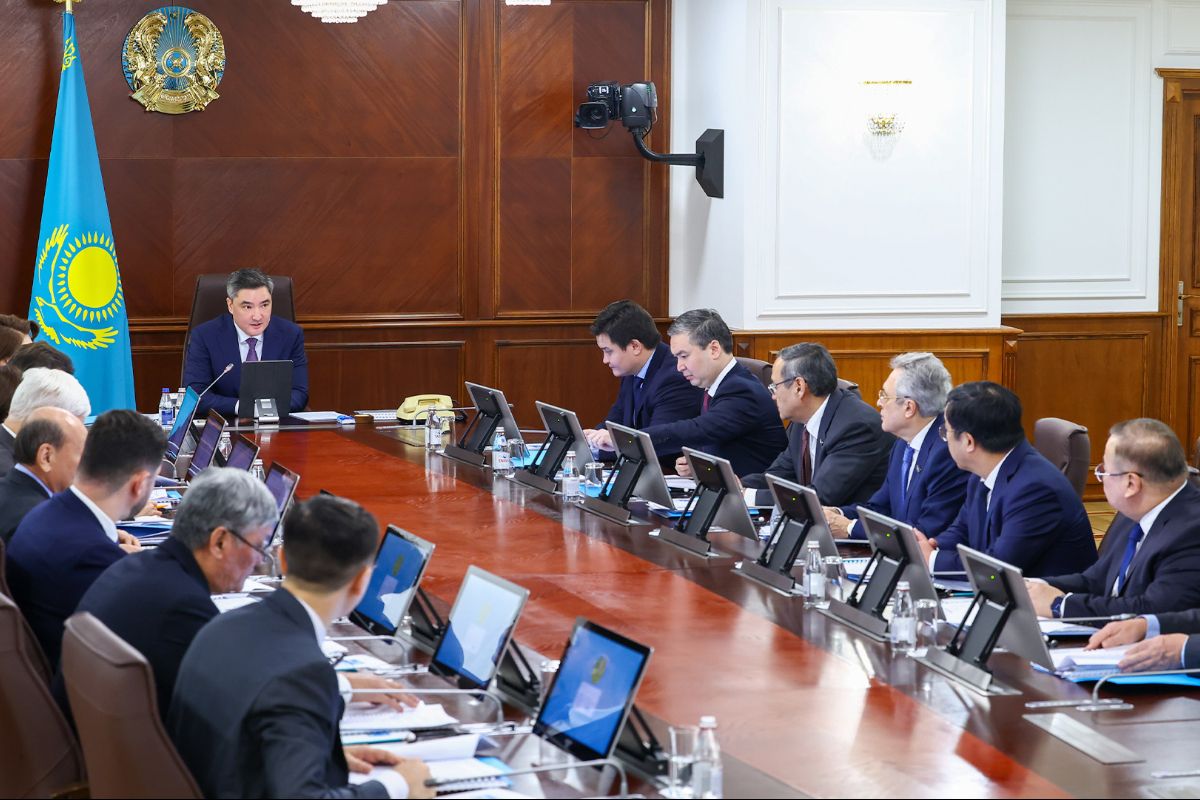
Prime Minister Olzhas Bektenov held a meeting with the participation of full members of the National Academy of Sciences, the leadership of government bodies, akims of several regions, and representatives of the business community on issues of science, implementation of scientific projects, and the involvement of the potential of the National Academy of Sciences in the development of various sectors of the economy, reports Primeminister.kz.
Within the framework of implementing the President’s instructions on the digital transformation of economic sectors, measures were discussed to strengthen cooperation between science and the real sector, as well as to support scientists.
Opening the meeting, the Prime Minister emphasized the importance of open and substantive explanation of the draft new Constitution. It was noted that the document reflects consistent political and economic transformations taking place in society and establishes new development benchmarks for the country, including priorities in education, science, and innovation.
“The draft new Constitution is a progressive document oriented toward the future. Its foundation is human-centeredness. The draft enshrines that the Republic of Kazakhstan recognizes the development of human capital as a strategic direction of state activity. We see active public support for enshrining in the Constitution the concepts of President Kassym-Jomart Kemelevich Tokayev on building a Fair Kazakhstan, the comprehensive implementation of the principle of ‘Law and Order,’ and ‘Taza Kazakhstan.’ The principles of responsible and constructive patriotism are placed at the forefront. The concept of ‘A Strong President – an Influential Parliament – an Accountable Government’ creates stability and predictability of the political system,” Olzhas Bektenov emphasized.
The timeliness of the constitutional reform was noted in light of rapid technological development, changing global trends, and the growing role of “middle powers.”
During the discussion, representatives of the scientific community expressed support for the draft new Constitution of the Republic of Kazakhstan. Particular emphasis was placed on initiatives to enshrine science as the foundation of sustainable state development.
“The draft new Constitution not only establishes human rights and freedoms as the main priority of the state, but also serves as the foundation for the long-term scientific and technological development of Kazakhstan,” President of the National Academy of Sciences Akhylbek Kurishbayev emphasized.
“The development of medical science is not only a matter of scientific progress, but also a key factor of national security and a resilient healthcare system. It is fundamentally important that in the draft new Constitution science is considered the foundation of sustainable state development. This means recognition that scientific knowledge, research, and scientific personnel are not auxiliary, but a strategic resource of the country,” Academician Vyacheslav Lokshin said, noting the need to elevate the field of ‘life and health sciences’ to a strategic level.
In this context, issues of implementing solutions based on artificial intelligence and big data, developing digital diagnostics and telemedicine, and strengthening the human resources potential of medical science were актуalized.
*****
Participants of the meeting exchanged views on increasing the contribution of science to the economy. Today, the state is implementing systemic measures to create the necessary conditions and stimulate investments from the business sector. Tax incentives of up to 300% of expenses for financing scientific developments have been introduced. The Budget Code enshrines the obligation of subsoil users to centrally allocate 1% of extraction expenses for research and development through a budget program. Over three years, funding for science from the republican budget has increased 3.5 times and amounted to 214 billion tenge in 2026. The President has set the task of increasing this indicator to 1% of GDP by 2029.
“Overall, extensive and serious work is being carried out to improve the efficiency of domestic science, its investment attractiveness, openness, and transparency of all processes. The Academy is called upon to become a key intellectual center supporting the country’s strategic development. It is here that scientifically grounded forecasts of economic development should be formed, as well as strong scientific ties with global centers of innovation strengthened,” Olzhas Bektenov noted.
President of the National Academy of Sciences Akhylbek Kurishbayev presented measures aimed at accelerating the implementation of scientific developments into the economy. It was noted that the Academy has made foresight a permanent planning tool: 70 regional and sectoral sessions were held with the participation of government bodies, science, and business; 220 promising tasks were formed; and 65 scientific and technical assignments were prepared for program-targeted financing. In addition, it was proposed to move to a new four-level balanced system of priorities and approve it at the platform of the Higher Scientific and Technical Commission. This decision will make it possible to solve strategic tasks and support fundamental science.
The importance of regional councils on science and technology created on the President’s instruction was noted. These councils are intended to become an effective mechanism for managing scientific and innovative development at the local level.
Reports on the practical impact of research and development work were presented by representatives of sectoral government bodies. Minister of Industry and Construction Ersayin Nagaspayev noted that over the past five years, enterprises of the mining and metallurgical complex invested about 150 billion tenge and implemented more than 1.5 thousand projects. The implementation of developments provides a direct economic effect and increases industrial safety.
In the agro-industrial complex, results of program-targeted financing and implementation of domestic developments were presented. Thus, 743 varieties and hybrids of domestic selection developed by subsidiary organizations of the National Agrarian Scientific and Educational Center are registered in the State Register. About 60% of sown areas are planted with Kazakhstani seeds. Over the past two years, 11 types of crop production products have been introduced to the market in the processing sector.
Proposals from regions on the development of the scientific and innovation ecosystem were also heard. Akim of Aktobe Region Askhat Shakharov presented data on the development of laboratory infrastructure at universities, implementation of projects in an innovation technopark, and attraction of foreign scientists. Akim of East Kazakhstan Region Nurymbet Saktaganov presented plans for developing research on rare earth and critical materials, expanding technology transfer and international cooperation, including a project under Horizon Europe.
Comments and proposals were also made by Doctor of Physical and Mathematical Sciences, professor in the field of nuclear energy safety, controlled thermonuclear fusion, radioecology, and radiation technologies Erlan Batyrbekov, and Doctor of Physical and Mathematical Sciences Askar Dzhumadildayev. It was noted that the Concept for the Development of Knowledge-Intensive Technologies approved by the Government in December 2025 creates conditions for the concentration of scientific potential, accelerated implementation of advanced technologies, and training of scientific personnel. Attention was given to issues of developing the silicon industry, including fundamental research in silicon studies and the construction of specialized plants, and their importance for the country’s technological development was emphasized.
Following the meeting, a number of instructions were issued:
The Ministry of Science and Higher Education, together with sectoral government bodies, by March 1, 2026, is to review the proposals of the Academy of Sciences on forming a new model for determining priorities of scientific and technological development.
Sectoral government bodies, by March 1, 2026, are to approve roadmaps for solving technological and production tasks and implementing applied scientific developments.
Akims of regions are to form and head regional scientific and technological councils. Together with the National Academy of Sciences, by April 1, 2026, approve scientific and technical assignments taking into account regional specialization and the results of foresight studies.
The National Academy of Sciences, by April 1, 2026, is to ensure the establishment of the Center for Scientific and Technological Foresight and conduct the relevant research.
The Ministry of Water Resources and Irrigation, together with the ministries of artificial intelligence and digital development, science and higher education, by May 1, 2026, is to ensure the launch of a project on the application of AI technologies in water resources management. Together with the National Academy of Sciences, by the end of 2026, prepare a map of the water and energy resources of Kazakhstan.